
Bleaching – teeth whitening – teeth bleaching
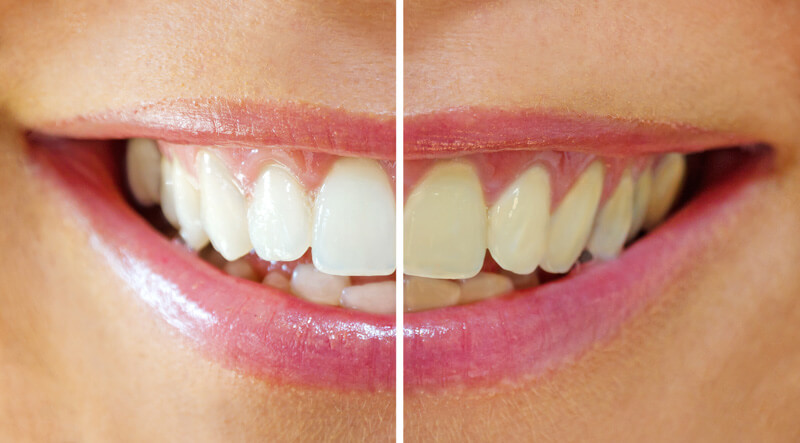
Bright white teeth are a symbol for health, success, attractiveness and self-confidence!
Unfortunately, teeth naturally become darker and more yellow with increasing age. The consumption of colouring food and stimulants leads to additional discolouring of the teeth. Drugs, root canal treatments and dental accidents can also make teeth look darker.
Would you like your teeth to look brighter? Our team will be happy to advise you personally in order to make your wish become reality.
Requirements for bleaching
Prior examination by the dentist and professional tooth cleaning are important prerequisites for successful teeth whitening.
- Fillings and other artificial materials inside the mouth (e.g. crowns or bridges) cannot be lightened.
- We may not use bleaching agents on pregnant women, nursing mothers or young people under the age of 18.
How it works
The bleaching agent penetrates into the surface layer of the tooth and breaks down the colour pigments, making the tooth appear brighter. The effect depends in principle on the duration of application. If the teeth are severely discoloured, multiple treatments may be necessary until the desired degree of brightness is achieved.
Current scientific research has shown that professional bleaching has no damaging effect on teeth: They are neither more susceptible to tooth decay, nor is tooth substance lost.
Home bleaching
If you want to bleach your teeth at home, Dr. Rast has a special splint made. The patient fills this splint himself with a bleaching agent and uses the splint daily for one to two hours. The duration and frequency of bleaching depends on the desired whitening degree. The splint can be used several times. Home bleaching is the most sustainable method for whitening teeth. As a general rule, the first teeth bleaching session takes about two weeks, so that the shade becomes lighter by two to three steps.
In office bleaching / power bleaching
You can also have your teeth bleached in a dental practice (in office bleaching): After tooth cleaning, the gums are covered tightly. A highly concentrated bleaching gel is then applied to the teeth to be treated. This treatment is repeated until the desired result is reached. In the dental practice, significantly higher concentrations of the bleaching agent are used than in home bleaching.
Walking (internes) Bleaching
Internal bleaching is the method for whitening root-treated teeth. Here, the dentist opens the root canal entrance and introduces the bleaching agent into the interior of the tooth. The entrance is then closed with a temporary filling. The result is evaluated after three to five days. The treatment is repeated until the desired result is achieved. Finally, the tooth is sealed tightly with a definitive filling..
Bleaching costs
The costs incurred depend on the type of bleaching (home/in office/walking bleaching) and possible preparatory work. We are happy to advise you personally and estimate the costs for you individually.
Useful Information for You
Questions About Teeth Whitening
There are two types of teeth whitening:
At-home whitening (wearing trays filled with a low-concentration bleaching agent daily for about 14 days) and in-office whitening (a high-concentration bleaching agent is applied several times at the dentist’s office and activated with a lamp for about 90 minutes).
Home bleaching is generally painless. In-office bleaching, however, can be painful during the procedure and for the first 1–2 days afterward due to the higher concentration of the bleaching agent; this pain can be managed with mild pain relievers.
Current scientific studies show that professional teeth whitening does not damage the teeth: they are neither more susceptible to cavities nor do they lose tooth structure. Without additional measures, but with good oral hygiene using a sonic toothbrush and regular professional dental cleanings, the effect lasts 1–3 years.
To achieve the best possible results, it is advisable to combine both methods.
Teeth whitening should not be performed on pregnant or breastfeeding women, or on patients under the age of 18. In any case, a thorough dental examination and professional teeth cleaning should be performed by a dentist before whitening.
At-home teeth whitening uses custom-made trays that you wear at home with a low-concentration whitening agent. The whitening process occurs gradually over several days or weeks and is easy to control.
With in-office teeth whitening, the whitening agent is applied directly at the dental office. It is more concentrated and works faster. This method is particularly suitable when a faster result is desired.
The Zahnarztpraxis am Schwanenplatz offers only at-home teeth whitening. The extent of whitening possible depends on the initial color of your teeth, the desired result, the sensitivity of your teeth, and your personal needs. The team at the Zahnarztpraxis am Schwanenplatz will provide you with personalized advice on at-home teeth whitening.
No, fillings, crowns, bridges, or veneers do not get lighter through teeth whitening. Only the natural tooth structure is whitened.
This is important to know if there are already fillings or ceramic restorations in the visible area. After teeth whitening, old fillings may no longer match the new tooth color perfectly and may need to be adjusted or replaced later.
Therefore, before teeth whitening, you should always check which restorations are present and what results are realistic.
After teeth whitening, your teeth may be slightly more sensitive for a short time. In the first few days, it’s a good idea to avoid strongly staining foods and beverages as much as possible. These include, for example, coffee, tea, red wine, curry, and berries. Smoking can also cause the results to fade more quickly.
During this time, be sure to practice good but gentle oral hygiene. Using an appropriate toothpaste and getting regular professional cleanings will help maintain the results for as long as possible.
The team at the Schwanenplatz Dental Practice will provide you with specific recommendations for at-home care after your teeth whitening treatment.
Yes, a professional dental cleaning before teeth whitening is highly recommended. This removes plaque, tartar, and stains so that the whitening agent can work more effectively.
In addition, a check is performed before treatment to ensure that your teeth and gums are healthy. Any active cavities, leaky fillings, or inflamed gums should be treated first before undergoing teeth whitening.
This ensures that the teeth whitening procedure is safer, more comfortable, and yields better results.