
White aesthetic fillings
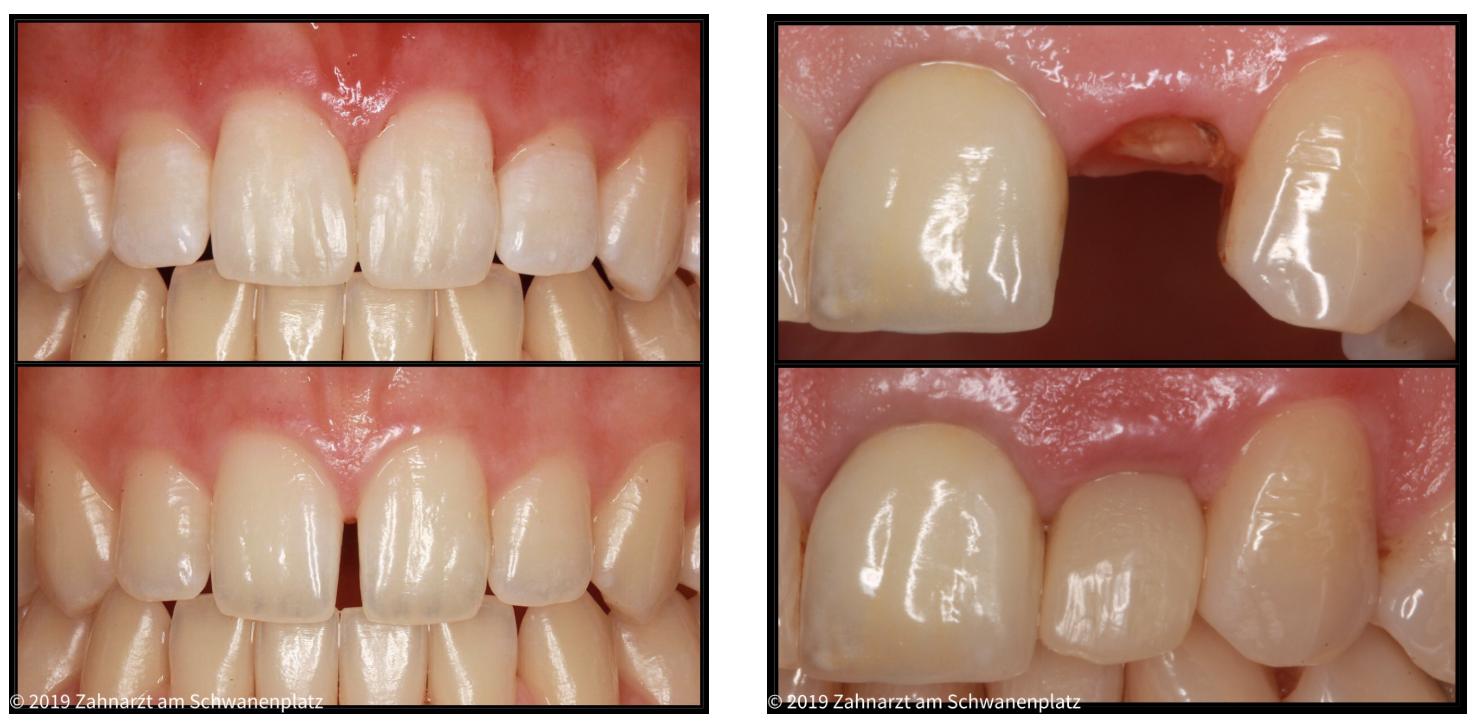
We replace hard tooth substance, which has been irrevocably lost, with tooth-coloured plastic fillings (composite) as minimally invasive as possible. In most cases, anterior teeth can also be reconstructed aesthetically and functionally well with composite.
- in case of caries
- in case of excessive wear (abrasion)
- after accidents (trauma)
- in case of acid influence by fruit acids, carbonic acid, acid bursting etc. (erosion)
- with wrong tooth cleaning techniques (horizontal “scrubbing”, too hard brush, too coarse grinding particles in paste, too much pressure) -> wedge-shaped teeth defects
- generally for small and medium-sized defects
- for minor aesthetic corrections (closing gaps / changing shape /position)
Process and material used
Composites are a mixture of finely ground ceramic glass powder and plastic. Ceramics give the fillings their stability and good appearance. The plastic holds everything together. Composites are nowadays available in various colour variations, so that in almost all cases a reconstruction which is invisible at speaking distance is possible.
Exposure to blue light initiates a chemical process that cross-links the individual plastic molecules with each other. This way the filling is cured. However, the plastic still shrinks during this process and releases forces on the remaining tooth walls. For this reason, acrylic is inserted into the tooth in several small portions using adhesive technique (bonding) in order to keep this effect as small as possible.
Whenever possible we put new fillings under the “dental dam”. We use a kind of latex cloth (alternative in case of a latex allergy) which is put over the teeth that need to be treated. Thus, we achieve dry, clear and almost bacteria-free working conditions. This demonstrably improves the quality and durability of fillings. No amalgam is used in our practice.
Costs of a dental filling
The costs for a composite filling depend primarily on the extent of the defect (how many surfaces of the tooth) and the type of tooth (front tooth, small molar, large molar). Any costs for pain control (anaesthesia) and additional measures such as the use of a laser are added.
We are happy to advise you individually and personally in order to find the ideal solution for you.
Useful Information for You
Questions About Dental Fillings
Tooth decay is a multifactorial infectious disease. Bacteria living in the oral cavity form a sticky film—known as plaque—on hard, non-renewable surfaces such as the teeth. If this plaque is not removed thoroughly and regularly, the bacteria can ferment sugars and carbohydrates in particular, thereby producing acids. The acids dissolve or demineralize the tooth enamel. This initially causes white spots to appear; later, the surface may even break down (forming a cavity), and the dentin is also affected. Only when the extent of demineralization is significant and the depth of the “cavity” is well advanced can symptoms such as sensitivity to temperature changes or sweet foods occur. The progression of tooth decay depends on the following factors:
- Oral hygiene (technique, frequency, tools)
- Diet (fermentable carbohydrates, quantity, and distribution throughout the day)
- Fluoride intake (toothpastes, mouthwashes, highly concentrated gels/varnishes)
- Quality and quantity of saliva (buffering acids / remineralizing the
- enamel)
- Time (interval between demineralization and remineralization)
Fillings and crowns can generally be used immediately. If your lips or cheeks feel numb, you should wait to eat or drink until you have fully regained sensation. If fluoride was applied after the treatment, we recommend waiting about 30 minutes.
If the gums have receded due to improper brushing techniques, teeth grinding, or periodontitis, the dentin in the neck and root areas of the tooth is exposed.
This part of the tooth contains tubules with nerve endings that are sensitive to pain. Mechanical, thermal, or chemical irritation can cause a sudden, sharp pain, which usually subsides completely in less than a minute. Consuming acidic foods, in particular, opens these “pores” even wider!
- So avoid acidic foods!
- Use soft-bristled toothbrushes without applying pressure.
- Use toothpastes with a low RDA (relative dentin abrasion) value; these are less abrasive on the tooth surface.
- Apply fluoride gel 1–2 times a week; if necessary, apply it directly to the affected area using a cotton swab.
- Your dental team can recommend ideal care products and provide samples.
- In particularly stubborn cases, a filling or desensitization treatment performed by your dentist using varnishes or a laser can be very helpful.
A square piece of latex sheeting—or a latex-free alternative—used to create a clear, sterile, and dry working area. For your safety, it keeps soft tissues out of the way and prevents instruments from being swallowed or inhaled. When removing old fillings, materials such as amalgam, gold, and other substances cannot enter the throat. The rubber dam is an integral part of modern dentistry.
Amalgam is a metal alloy containing mercury. Amalgam fillings release metal ions into the oral cavity, for example, during chewing. Mercury can accumulate in organs such as the brain and kidneys. Accordingly, symptoms of mercury poisoning may include trembling fingers, eyelids, and lips; personality changes; slurred speech; and kidney inflammation.
When placing or removing an amalgam filling, vapors or aerosols containing mercury are released. In most cases, the patient can be protected by using a rubber dam during the procedure. Mercury levels in the blood typically return to normal within weeks to months.
Direct contact with amalgam fillings can cause local reactions in the mucous membranes (lichenoid lesions). If other metallic materials are present in the oral cavity, corrosion and a metallic taste may occur.
If amalgam fillings have been properly placed, are tight and well-polished, and no contact lesions are present, they can be monitored over time. Of course, replacement may be considered for aesthetic reasons.
Fluoride acts primarily in the mouth, directly on the tooth enamel, by:
- increasing the enamel’s resistance to acid
- slowing the demineralization of the enamel
- promoting the re-deposition of minerals from oral fluids into already demineralized enamel, so that even early-stage tooth decay can be stopped and, in some cases, even reversed.
Here’s how to best use fluoride for cavity prevention:
Use only fluoridated table salt in the kitchen and at the table
Once most of the baby teeth have erupted, the child is already eating adult food and thus also benefits from the preventive effects of fluoridated salt.
Brushing Teeth with Fluoride Toothpaste
Children
Starting when the first baby tooth erupts, use “children’s toothpaste” containing 0.05% fluoride. A “dab” of fluoride-containing children’s toothpaste is sufficient Once the first permanent molar erupts (no later than age 6), use “junior toothpaste” or “adult toothpaste” containing up to 0.15% fluoride.
Adults
It’s best to brush your teeth after every meal with fluoride toothpaste, but at least twice a day. One brushing per day should be particularly thorough.
Important for children and adults
Spit out the toothpaste after brushing, but do not rinse with water; this allows the toothpaste to be even more effective.
To supplement these basic measures, children aged 6 and older who are at increased risk of tooth decay are recommended to brush their teeth once a week with fluoride gel (which contains about 10 times more fluoride than adult toothpaste) or to rinse their mouths daily with a fluoride solution.
What the Dentist Can Do Additionally
Fluoride varnishes have proven to be very effective in protecting areas of the teeth that are particularly susceptible to cavities, such as newly erupted permanent molars. These products can also successfully halt cavities in their early stages. For certain conditions, it may be advisable to fabricate medication carriers or trays to allow fluoride gel to act locally on the teeth over an extended period. Dr. Rast can also prescribe Duraphat toothpaste, which has an extremely high fluoride content and can be particularly helpful in preventing root caries in older patients.
However, even optimal fluoridation of your teeth does not exempt you from continuing to practice thorough oral hygiene and maintaining a “tooth-friendly” diet.
Depending on the situation, various materials can be used for dental fillings. At the Zahnarztpraxis am Schwanenplatz, we use composite fillings and ceramic fillings, among others.
Composite fillings consist of a mixture of plastic and finely ground ceramic components. Their color can be easily matched to that of natural teeth, making them particularly suitable for aesthetic, tooth-colored fillings.
For larger cavities, a ceramic filling may also be a good option. These can be precisely designed and fabricated using the CEREC system. Ceramic is metal-free, biocompatible, durable, and offers a very natural appearance.
The most suitable material depends on the size of the cavity, the location of the tooth, the stress it will be subjected to, and aesthetic considerations. The team at the Schwanenplatz Dental Practice will provide you with personalized advice and recommend the best solution for you.
How long a dental filling lasts depends on the material used, the size of the filling, the location of the tooth, the amount of chewing pressure, and oral hygiene. With proper care, small to medium-sized composite fillings can last for many years. Ceramic fillings are generally particularly durable and are especially suitable for larger cavities or teeth subjected to heavy chewing pressure.
Regular checkups are important so that leaking edges, wear, or new cavities can be detected early. This helps ensure that a filling lasts as long as possible.
No, an old filling does not automatically need to be replaced. As long as it is sealed, holds well, and there are no symptoms or new cavities, it can be monitored.
Replacement may be advisable if the filling is damaged, has come loose, the edges are leaking, decay is forming underneath, or for aesthetic reasons. During your checkup, the team at the Zahnarztpraxis am Schwanenplatz will assess whether a filling is still intact or if replacement is recommended.
Mild discomfort or temporary sensitivity after getting a filling can be normal. The tooth may be particularly sensitive to cold, heat, sweet foods, or pressure during the first few days. This usually subsides on its own.
If the pain gets worse, occurs when biting down, lasts longer, or the tooth throbs severely, the filling should be checked. Sometimes the filling is slightly too high, or the tooth was already more irritated. In such cases, the cause can be determined and treated at the dentist’s office.