
Root canal treatment

In a case of very advanced caries, the bacteria can infect the “tooth nerve”. As a result, a possibly painful inflammation develops. If the infection persists for a longer period of time, the “tooth nerve” dies and decomposes. The bacteria multiply, penetrate to the tip of the root and cause an infection in the surrounding bone. Even a “pus tooth” (abscess) can develop as a result.
Dental accidents, untreated periodontal diseases and other diseases can also lead to the death of a tooth and the need for root canal treatment.
The goal of the treatment is to disinfect the bacteria-infected canal system inside the tooth.
Process
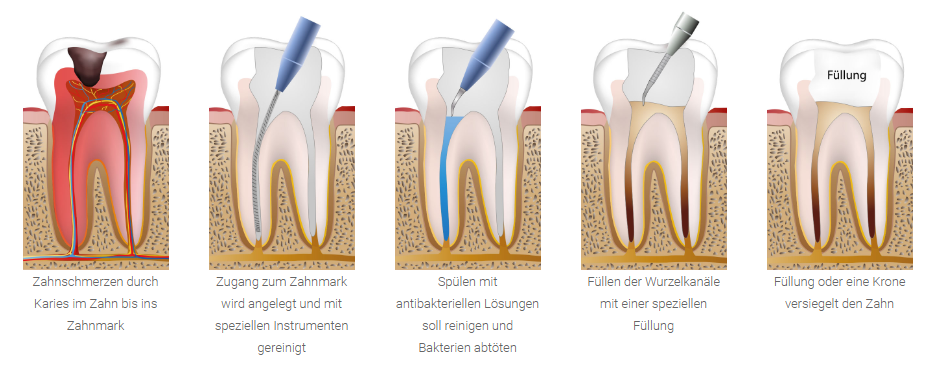
The following steps are necessary:
- length measurement of the root canals via X-ray and electronic means
- mechanical preparation by rotating flexible files
- disinfecting, tissue dissolving rinses
- medicamentous inlays
- bacteria-proof root canal fillingbakteriendichte Füllung der Wurzelkanäle
For an optimal treatment result, we use state-of-the-art preparation systems with electrical length measurement and highly flexible disposable instruments. The decisive factor for the long-term success of a root canal treatment is the final, bacteria-proof closure of the tooth to the oral cavity.
Costs of root canal treatment
The cost of a root canal treatment varies depending on the number of root canals and the number of sessions required. We are happy to advise you individually.
Useful Information for You
Questions About Root Canal Treatment
A root canal treatment is necessary when the tooth’s nerve is severely inflamed or has already died. Common causes include deep cavities, leaky fillings, a dental injury, or a crack in the tooth.
Typical signs may include severe toothache, pain when chewing, increased sensitivity to heat or cold, swelling, or a feeling of pressure. Sometimes, however, an affected tooth causes hardly any symptoms and is only detected during an examination or on an X-ray.
The goal of root canal treatment is to eliminate the inflammation and preserve the natural tooth as much as possible.
A root canal treatment is usually performed under local anesthesia and should therefore not be painful. Many patients associate root canal treatment with anxiety or unpleasant experiences, but today the procedure is generally well managed.
During the procedure, the inflamed or dead tooth nerve is removed, the root canal is cleaned and disinfected, and then sealed tightly. The team at the Schwanenplatz Dental Practice works calmly and carefully, explaining each step to you as they go.
After the procedure, the tooth may be temporarily sensitive. These symptoms usually subside on their own.
The duration of a root canal depends on which tooth is affected, how many root canals need to be treated, and how advanced the inflammation is.
In many cases, a single session lasts about 60 minutes. Depending on the situation, multiple appointments may be necessary—for example, if the tooth is severely inflamed or the root canals are particularly complex.
After cleaning and disinfection, the tooth is sealed tightly. Depending on the extent of tooth structure loss, a filling, partial crown, or crown may be recommended later to ensure the tooth remains stable in the long term.
Yes, in many cases, a tooth that has undergone root canal treatment can be preserved for a long time. That is precisely the goal of the treatment: The natural tooth is not removed, but rather cleaned from the inside, disinfected, and sealed tightly again.
It is important that the tooth is properly cared for after root canal treatment. Depending on how much tooth structure has been lost, a simple filling may be sufficient, or a crown may be recommended. This protects the tooth from further damage and ensures it remains strong enough to withstand chewing.
Regular checkups help monitor the long-term success of the treatment.
If an inflamed or dead tooth nerve is left untreated, the inflammation can spread further. This can lead to more severe pain, swelling, pus formation, and an abscess.
The bacteria can reach the jawbone and cause inflammation there. In some cases, the only option left is to remove the tooth.
A root canal can help prevent such consequences and preserve the natural tooth as much as possible. That’s why persistent toothaches, pressure-related discomfort, or swelling should be evaluated by a dentist as soon as possible.