
Prophylaxis / dental hygiene
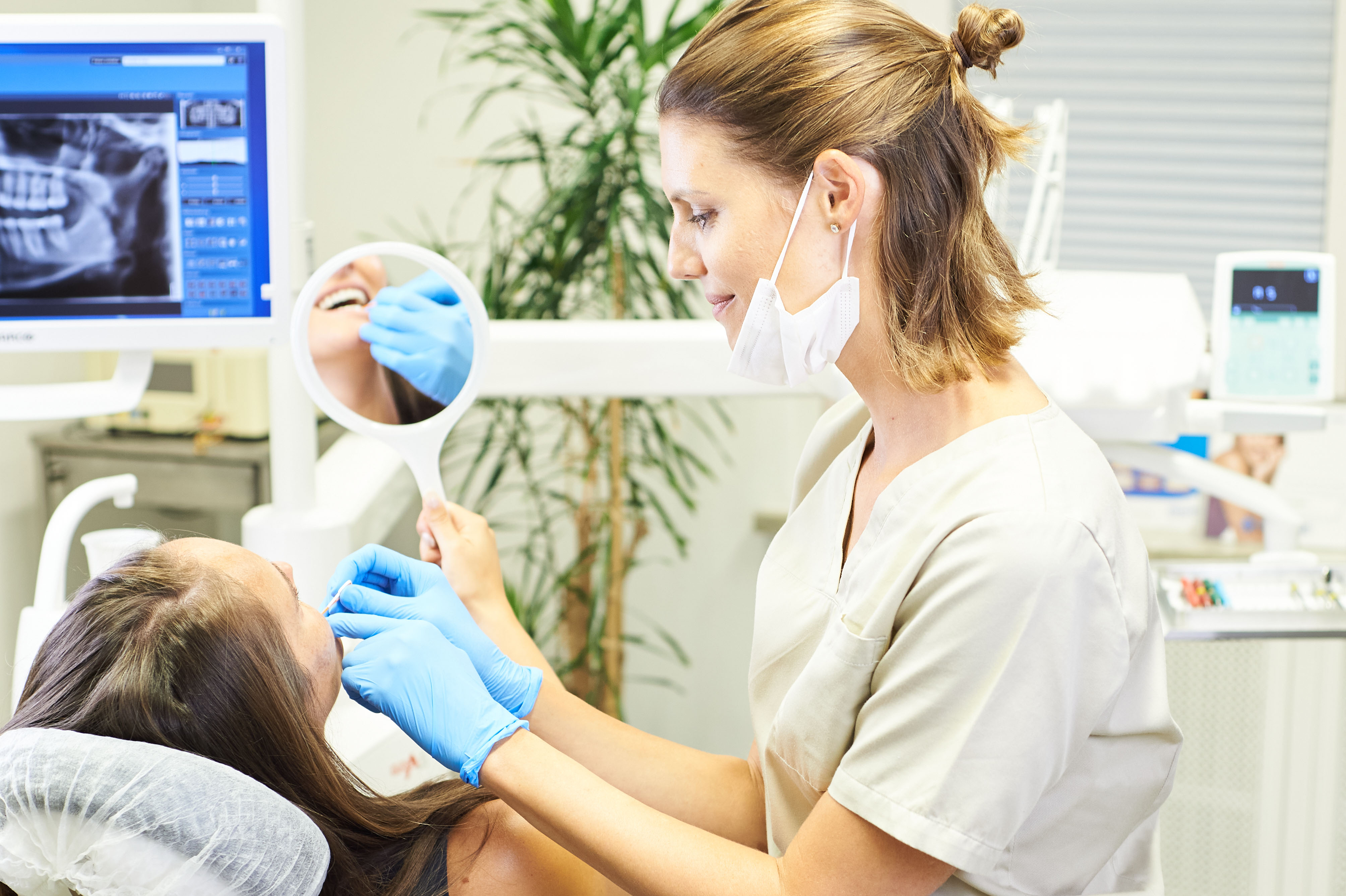
In order to offer you the best possible prevention of caries, gingivitis and periodontitis, we recommend that you visit your dental hygienist or prophylaxis assistant regularly. Regular checks are also important after a treatment with implants and dental prostheses as well as after periodontitis treatment!
The right prophylaxis both in our practice and daily at home saves you a lot of time, effort and money.
When is professional tooth cleaning indicated?
The frequency or distance between the tooth cleaning sessions is determined by our dental hygienist or prophylaxis assistant by means of individual risk assessment. Even in healthy condition, you should check and professionally clean your teeth at least once every calendar year. X-rays are usually taken every 24 months. For customers suffering from an inflammation of the dental bed, severe discolouration or a high risk for caries, intervals of 6 or even 3 to 4 months may be necessary. Bei Kunden mit einer bestehenden Zahnbettentzündung, starken Verfärbungen oder hohem Kariesrisiko, können Intervalle von 6 oder sogar 3 bis 4 Monaten notwendig sein.
The tooth cleaning process
- Examination, possibly including x-rays
- Oral hygiene motivation / instruction
- Removal of tartar, plaque and possible discolourations
- Possible additional treatments, such as the use of lasers, special rinses etc.
- polishing, fluoridation
- Determination of the interval until the next tooth cleaning and possible referral to the dentist
Dental hygiene costs
Costs depend on the treatment time, whether x-rays are due and whether an examination by the dentist is indicated. We are happy to advise you individually and personally.
Useful Information for You
Questions About Dental Hygiene
A dental prophylaxis assistant cleans the teeth above the gum line and educates and motivates patients so they can maintain optimal oral hygiene on their own. However, a dental prophylaxis assistant is not trained to make diagnoses, which means patients must see a dentist for a checkup at least once a year. This level of expertise is particularly suitable for young patients and clients without gum disease.
A dental hygienist is authorized to make diagnoses on their own. They treat patients with periodontitis who have deep pockets between the teeth and gums. Treatments performed by a dental hygienist are often somewhat more uncomfortable, as the cause of the inflammation (tartar) must be removed from deep within the tissue. Generally, treatment by a dental hygienist is slightly more expensive than that provided by a dental hygiene assistant due to the higher level of training and the more time-consuming nature of the procedures, but it is definitely worth it.
Within minutes, a thin film called a “pellicle”—essentially a thin layer composed of saliva components and mucosal cells—forms on a clean tooth surface. Within the first 24 hours, the first pioneer bacteria can attach themselves to this pellicle, where they multiply and form colonies. This results in a kind of “community” of microorganisms that support one another, mature, and provide the foundation for further bacterial growth.
Some of these bacteria produce acids that erode the tooth surface, while others produce metabolic byproducts that lead to gum inflammation and bone loss. A disinfectant mouthwash alone would only kill bacteria very superficially. This layer is quickly replaced due to rapid bacterial growth. For this reason, it is essential to mechanically disrupt the plaque—the biofilm on the tooth—for example, with a toothbrush. If this sticky film is not removed, it “hardens” into tartar due to minerals contained in saliva.
There are studies showing that a manual toothbrush can clean just as well as an electric toothbrush. But not in the same amount of time, and only if the patient receives ideal instruction and uses it correctly. Is that realistic in everyday life? No. We all have busy schedules and many demands. Time is limited, and stress levels are high. In other words, in everyday life, an electric toothbrush is vastly superior for the average user!
An electric toothbrush should ensure the best possible removal of plaque while being as gentle as possible on tooth enamel and gums.
In this regard, sonic toothbrushes—which cause an elongated brush head to vibrate (at least 30,000 times per minute)—are clearly superior. We carry a selection of suitable brushes at our practice and would be happy to advise you.
Round, rotating heads clean well but can push back the gums and damage exposed tooth roots. This leads to unsightly, elongated, and notched tooth necks, which can be sensitive to stimuli (cold, sweet, sour, or touch) and are more prone to tooth decay.
The spaces between the teeth are inaccessible to a toothbrush. This makes it all the more likely for dental plaque to build up in these areas. We now know that after 24–48 hours, plaque has matured to the point where it produces acids and metabolic byproducts that damage the teeth or the gum tissue. Inadequate cleaning of the spaces between the teeth can also cause bad breath. Consequently, thorough cleaning of these spaces is essential to maintain good oral health and avoid high dental costs.
For younger patients with relatively narrow interdental spaces, we recommend dental floss. For wider interdental spaces or in cases involving bridges and implants, we recommend interdental brushes or other aids (instructions provided by the dental hygienist).
Interdental brushes are used to clean between teeth, especially in cases of wide gaps, implants, crowns, and bridges. They consist of a piece of wire covered with bristles on all sides and fitted with a handle or holder.
Different diameters are available to ensure optimal cleaning for each individual.
Usage:
- Choose the largest brush that will just fit through the space between your teeth.
- Insert the IDB all the way through the space from the outside to the inside without injuring your gums.
- Move the brush back and forth a few times, following the contours of both adjacent teeth (adapting to the shape).
- The brushes can be used multiple times, but if the wire is bent or the bristles are damaged, they must be discarded.
For most patients, a dental cleaning once or twice a year is recommended. During the procedure, plaque and tartar are thoroughly removed, the teeth are professionally cleaned, and potential problems are detected early.
However, the recommended frequency of dental hygiene appointments depends on your individual oral health. If you have gum problems, periodontitis, dental implants, heavy tartar buildup, or an increased risk of cavities, more frequent appointments may be advisable. Your dental hygienist or dentist will recommend the appropriate schedule for you based on your individual needs.
A professional teeth cleaning is generally not painful. Depending on the sensitivity of your teeth or gums, it may be slightly uncomfortable in some areas—for example, if you have exposed tooth necks, gum inflammation, or heavy buildup.
We take the gentlest approach possible and tailor the treatment to your individual situation. If you have sensitive teeth or are unsure, please feel free to let us know before the treatment. This allows us to work with extra care or, if necessary, administer a local anesthetic.
During a dental hygiene appointment, your teeth, gums, and mouth are carefully examined. If necessary, X-rays are taken to assess the situation more accurately.
You will then receive personalized oral hygiene instructions with tips on proper dental care at home. Afterward, tartar, plaque, and any discoloration are thoroughly removed. Depending on the findings, additional measures may be recommended, such as the use of a laser or special rinses.
Finally, your teeth are polished. You’ll also work together to determine the appropriate interval for your next dental cleaning. If dental treatment is necessary, you’ll be referred to a dentist.